Tuesday, June 26, 2012

June 26: International Day of Torture Survivorsd

www.AmnestyAmherst.blogspot.com
FOR IMMEDIATE RELEASE
June 26, 2012
CONTACTS: Mohamed Elgadi & Martha Speigelman, Coordinators 215-870-7809 mohamedelgadi@yahoo.com


“They took me to a secret prison where I was subjected to electric shocks to my vagina.” Nora, from Honduras (Torture Abolition and Survivors Support Coalition, Survivor Testimonies)
“The torture inflicted on me was intolerable, especially the use of electric shocks and anal
penetration using solid objects.” Unidentified male victim (Group Against Torture in Sudan, Survivor Testimonies)
“My father does not want to talk about his experience after all these years. I can see and feel the mental damage of torture on him.” Mamoun, a child of a torture survivor, Albany, NY
“I will never forget what I experienced. But I’m trying to rebuild my destroyed life.” TK, Kosovo (International Rehabilitation of Torture Victims, Survivor Testimony)

Amherst, MA-In its effort to combat torture, the United Nations proclaimed June 26 as the International Day in Support of Victims of Torture and, as the former Secretary-General Kofi
Annan declared, "an occasion for the world to speak up against the unspeakable." This day is an opportunity to stand up together against this cruel crime against human rights.

The United Nation’s theme for this year’s torture survivor’s campaign is rehabilitation.
Rehabilitation can be effective in empowering torture victims to resume as full a life as possible, as noted by many human rights advocacy groups. Nonetheless, community support is a key in this journey, according to many victims. “If it was not for my family, close friends and neighbors, I do not think I could have survived” reported one of the half-million survivors who live in the United States. It takes time and resources to re-build the intentionally destroyed lives of those who were targeted by the government-supported torture establishment.

Amnesty International’s Amherst Group 128 observes the United Nations’ International
Day for Torture Survivors this June 26th with cautious optimism. President Obama reiterated his strong stance against torture and considers the CIA Enhanced Interrogation Techniques as torture. However, many voices within the Administration continue to give mixed messages about their stance toward torture.
We believe that torture against one person is a crime against all of us.

Sunday, April 15, 2012

Over a month since the arrest of Jalila Khamis Koko from her home in Khartoum – Sudan
Urgent Action: Jalila Khamis Koko, April 15, 2012 – Age: 43 – married and a mother
Occupation: Teacher at a Primary Stage School.
Date of Arrest: Wednesday, March 14, 2012
Where was she arrested: Shajara City, Khartoum – Sudan.
Affiliation: SPLM-N (Sudan Peoples’ Liberation Movement-North), and a human rights activist. Over month passed since raid of Ms. Jalila Khamis Koko’ home in the city of “Alshajara” south Khartoum at about 2:30 a.m. of Wednesday, March 14, 2012 by the Sudanese National Intelligence and Security Services (NISS) agents, they were escorted her with pajamas on to the offices of intelligence and national security and still in custody so far. Sudanese Network for Human Rights is deeply concerned about the continued detention of Ms. Jalila Khamis Koko, and call on Sudanese authorities to immediately release Ms. Jalila, since no valid legal charges have been made.

Friday, March 16, 2012

Western Mass. Area Meeting 3/10

A very successful joint meeting hosted by Amnesty Chapter @ Hampshire Collge and included representatives of Mt. Holyoke Collge and Amherst Chapter (Group-128). Cynthia Gabriel gave a powerful presentation reflecting on the 50-year history of Amnesty International in the US. She also shared a lot of useful materials on using media and "Tools and Tips for Effective E-Activism"
including the use of Social Media tools like Facebook and Twitter.

Wednesday, February 29, 2012

Western Mass. Annual Groups Meeting

Amnesty International invites you to our annual Western Massachusetts’ Meeting Saturday, March 10, 2012 11:00AM-2:00PM Hosted by Hampshire College AI Student Group
(Location: Hampshire College, 83 West St., Amherst, MAFranklin Paterson Hall, East Lecture Hall)

This meeting is a great opportunity to learn more about Amnesty International’s campaigns, actions, resources, local events, and mission. We will provide skill based trainings that are essential for effective individual, local and student group activism. Most importantly participate and network with other human rights activists!

For more information and to RSVP contact Cynthia Gabriel Walsh at AI’s Northeast Regional Office 617-623-0202 or cgabriel@aiusa.org refreshments & lunch will be served

Sunday, January 22, 2012

Iran: Over 600 persons executed in 2011


Amnesty International Urges Iran to Halt Execution of American Amir Hekmati After Unfair Trial; Group Fears Execution Could be Carried Out Within Weeks

Amnesty International said today Amir Hekmati, an Iranian-American, sentenced to death in Iran for alleged spying for the C.I.A. did not receive a fair trial and had no access to a lawyer, diplomatic assistance or his family -- in violation of international law.
The human rights organization called on Iran to set aside the death sentence against the Arizona-born Helmati but said it fears he could be executed within weeks. Hekmati, 28, who had served as an Arabic translator in the U.S. Marine Corps, was accused of spying for the C.I.A. and sentenced to death for "collaboration with a hostile government." His appeal against this conviction and sentence must be lodged within 20 days.
Hekmati was held without access to his family, a lawyer or consular assistance after his arrest in August last year, in violation of international law. Before he was tried in December, he was made to participate in a televised "confession" -- a further violation of his right to a fair trial. Hekmati is the first American to be sentenced to death in Iran since the Islamic revolution in that country more than 30 years ago. "Like many other detainees in Iran, Amir Hekmati did not receive a fair trial and we question the timing and political circumstances of this decision," said Ann Harrison, Amnesty International's interim director for the Middle East and North Africa. "We know from past experience that the Iranian authorities sometimes rush forward with executions of political prisoners -- including dual nationals -- at politically sensitive times and we fear that this execution could happen within days or weeks."
Elise Auerbach, Iran specialist for Amnesty International USA, said: "The Iranian authorities often air highly suspect confessions which are obtained through coercion or torture. Mr. Hekmati was shown on Iranian television 'confessing' to carrying out espionage against Iran. Amnesty International urges the Iranian authorities to set aside this death sentence. The death sentence for Hekmati comes at a time of heightened tensions between Iran and the United States, amid announcements that Iran has begun uranium enrichment and the United States has strengthened sanctions against Iran. The Iranian authorities have executed political prisoners in January over the past two years, in relation to the unrest following the disputed presidential election of 2009.
"The lives of political detainees on death row in Iran are hanging in the balance this month," said Harrison. These executions have widely been seen as warnings to potential opposition protesters ahead of yearly celebrations marking the February 11 anniversary of the Iranian Revolution when people are encouraged to demonstrate in large numbers in support of the state. Zahra Bahrami, who held dual Dutch-Iranian nationality, was executed for alleged drugs offenses in January 2011 while awaiting trial on political charges related to the post-election unrest. Iranian activists on death row include Gholamreza Khosravi Savajani, an alleged supporter of the People's Mojahedin Organization of Iran (PMOI) who reportedly spent more than 40 months in solitary confinement in various detention centres in Iran, is also facing execution.
Three alleged PMOI supporters -- Ali Saremi, Ja'far Kazemi and Mohammad Ali Haj Aghaei -- were executed in Iranin 2010 and 2011. All men had been convicted of moharebeh (enmity against God) in relation to contacts with the PMOI.
Blogger Vahid Asghari, who had hosted websites critical of the government, was sentenced to death on Friday after conviction in an unfair trial of "corruption on earth" for allegedly organising a "pornographic" network against Islam and the state. Asghari had been held since May 2008. In October 2009 he said in a letter to a judge that he had been subjected to torture, forced to make a televised "confession" and forced to make spying allegations against high profile blogger Hossein Derakhshan.
Saeed Malekpour, a 36-year-old web designer and permanent resident of Canada, is also under sentence of death following a retrial on similar charges, which may be linked to Vahid Asghari's case. A previous death sentence was reportedly overturned in June 2011. The government has officially acknowledged executing 17 people already this year, although Amnesty International has received information suggesting at least 39 people may have been put to death in the first week of 2012 alone.
In December, Amnesty International highlighted a massive wave of executions in Iran throughout 2011, with over 600 people being put to death between the beginning of 2011 and November. Most of these were for drug related offenses. The scope of the death penalty is very broad in Iran and thousands are believed to remain on death row. Amnesty International opposes the death penalty in all cases as the ultimate violation of the right to life.
Read more on Iran Human Rights org

Sunday, December 11, 2011

Human Rights Day 2011


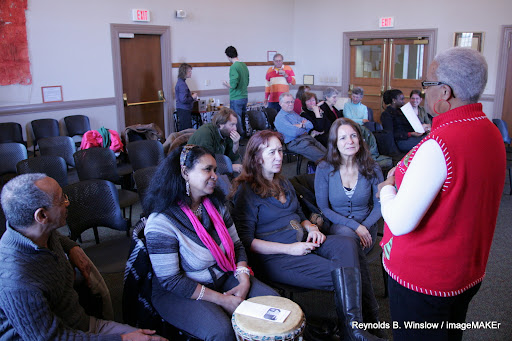
The Human Rights Commission of Amherst Town along with Amnesty International Chapter (Group 128) held its annual celebration event in the Town Hall to mark the Human Rights Day... artists came to participate from as far as Holyoke City and Manchester, NH... 2 popular Sudanese artists (refugees from Sudan) participated; Abdalla Mohamed Abdalla (Flute) and Tamador Gibreel (Drum & Vocal)...
In this photo (by Reynolds Winslow) The Human Rights Director of Amherst Town, Eunice Torres, speaks with artists before their performance... Also, next to Tamador, sits activist Fanny Rothschild. Fanny is an important voice for Sudanese refugees in the Pioneer Valley and helping a lot in exposing the human rights violations in Sudan. The actions of Fanny and many other activists in the Valley helped to save the Girifna leaders (a human rights group) from torture on the hands of the sudanese regime.


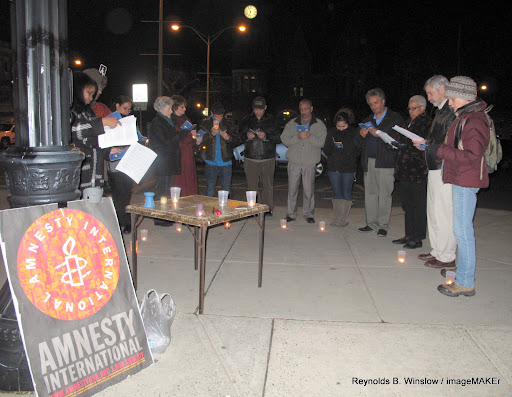
Prior to this event, a group of 20 activists hold a candle vigil the night before and reflected on the human rights around the globe while they read the 30 Articles of the Universal Human Rights Declaration

Happy Human Rights Day....

Sunday, December 4, 2011

Human Rights Day 2011

Photo source
From the UN Website
"This year, millions of people decided the time had come to claim their rights. They took to the streets and demanded change. Many found their voices using the internet and instant messaging to inform, inspire and mobilize supporters to seek their basic human rights. Social media helped activists organize peaceful protest movements in cities across the globe - from Tunis to Madrid, from Cairo to New York - at times in the face of violent repression.
Human rights belong equally to each of us and bind us together as a global community with the same ideals and values. As a global community we all share a day in common: Human Rights Day on 10 December, when we remember the creation 63 years ago of the Universal Declaration of Human Rights.
On Human Rights Day 2011, we pay tribute to all human rights defenders and ask you to get involved in the global human rights movement."

Come and join us in downtown Amherst on Fri 12/9 @ 6pm (at the corner of Main and South Pleasant streets) in our annual vigil to observe this important day... The Town's Human Rights Commission and many other human rights activists will be gathering to read the 30 articles of the Universal Declaration of Human Rights.

Tuesday, October 25, 2011

Human Rights Composer: Nigel Cox


Our dear long-time member of Amnesty International and UMass music professor emeritus Nigel Coxe was featured in the current issue of Amherst Bulletin


He performed last weekend at UMASS Amherst in honor of the 200th anniversary of the birth of Hungarian composer Franz Liszt.


read more here:
Lisztomania! Local pianist traces his training to Franz Liszt

Wednesday, September 21, 2011

"Georgia has just killed Troy Anthony Davis"


"After a torturous delay of more than 4 hours, the state of Georgia has just killed Troy Anthony Davis."

  wrote Amnesty International in a Press release just went out few minutes ago..
The state of Georgia may have taken one life tonight, but they cannot stop our struggle for all the Troy Davises of the world.

I just came back from Downtown Amherst... all the joy we've had earlier in the night has gone and replaced by sadness and anger....
A short few hours of hope that not lasted....

let's wipe our tears... and continue the hard work ahead...

Slight Hope: Execution on Hold for Troy Davis

http://news.blogs.cnn.com/2011/09/21/lawyers-file-appeal-to-stay-troy-davis-execution/


The joy after they heard
the good news

 
The anger @ 7pm in
downtown Amherst

 "The state of Georgia isn't proceeding with the execution until the U.S. Supreme Court rules on Davis' request for a stay. Davis' attorneys filed the request about an hour before Davis' scheduled 7 p.m. execution.

Davis' supporters, who had been chanting, are now letting out cheers as drivers pass and honk their horns. Otherwise, the mood is tense as they wait for a development, Lacey-Bordeaux reports."
In Amherst, MA, a large crowd of students, human rights activists rallied in downtown and forced traffic to slow and blocked the main road at 7pm, the time of the execution.


Ester and the tears of joy

A moment of joy when the good news arrived

Friday, September 16, 2011

Don’t Let Georgia Kill Troy Davis


Posted by: Laura Moye, September 7, 2011 at 1:36 PM
The day is now here – the state of Georgia has set Troy Davis’ execution datefor September 21st.
The U.S. Supreme Court refused to hear his final appeal earlier this year. But the story remains the same – Troy Davis could very well be innocent.
However, in the state of Georgia, the Board of Pardons & Paroles holds the keys to Troy’s fate. In the days before Davis’ execution, this Board will hold a final clemency hearing – a final chance to prevent Troy Davis from being executed.
Davis was convicted on the basis of witness testimony – seven of the nine original witnesses have since recanted or changed their testimony.
One juror said in a CNN news interview:“If I knew then, what I know now, Troy Davis would not be on death row.”
I know it’s difficult to believe that a system of justice could be so terribly flawed, but keep in mind that Troy has survived three previous execution dates, because people like you kept the justice system in check!
We’ve been bracing for this moment and the time for action is now! Here’s what you can do to join the fight:
1. Sign our petition to the Board of Pardons & Paroles urging them to grant clemency! We’ll deliver your signatures next week.
2. Organize for Troy: Take to the streets with us on Friday, September 16th! Sign up to organize a rally to stop the execution of Troy Davis. And RSVP for the International Day of Solidarity on Facebook.
3. Join our #TooMuchDoubt Twitter campaign: Spread the word about this injustice by tweeting a “Doubt a Day” about Troy’s storyTo Amherst Human Rights Commission, and human rights and justice activists,

Group-128 Action Campaign: This Friday, September 16, Amnesty International, Equal Justice, and other organizations are holding actions around the country to try to stave off the execution of Troy Davis in Georgia. We are looking for individuals and organizations, such as the Amherst Human Rights Commission, to participate. Right now we are thinking of a stand-out in Amherst center and the collection of signatures to FAX imediately afterwards to the Georgia Board of Pardons and Parole. A time has not been determined but lunchtime, noon to 1:30, let's say, may be appropriate.
You probably know most of the story--- witnesses recanting their trial statements and the fact that there has been no physical evidence connecting Davis to the killing of a police officer. In fact, there have been statements that another person admitted to the crime. Nevertheless, an execution date (the fourth one) has been set for September 21. It would be a grave injustice for this execution to go forward and certainly an indelible blot on the name of Georgia.
Please let me know whether you can be part of a Friday action. And, please forward this email to anyone who cares about justice.

Best regards,


Martha

Thursday, August 18, 2011

POC: Ayatollah Boroujerdi (Iran)


Case Summary
Ayatollah Sayed Hossein Kazemeyni Boroujerdi, a 50-year-old Shi’a cleric, is currently imprisoned in Iran for his peaceful religious opinions. Amnesty International considers him to be a prisoner of conscience. Ayatollah Boroujerdi was reportedly ill-treated in detention. He suffers from a number of serious medical conditions including high blood pressure, a cardio-vascular disorder, and a kidney ailment. He has reportedly lost a considerable amount of weight in detention. He has not been receiving necessary medical treatment in detention and there is a serious concern that his health is deteriorating. He had originally been held in Evin Prison in Tehran but was transferred to a prison in Yazd in early December 2008 where he is reportedly only allowed contacts with other people for 15 minutes a day.

Ayatollah Boroujerdi advocates the removal of religion from the political basis of the Iranian state. He was arrested at his home in Tehran on 8 October 2006 along with more than 300 of his followers, during violent clashes with security forces. He and 17 followers were initially sentenced to death, but the death sentences were later dropped. On 13 August 2007 he was sentenced to serve one year in prison in Tehran, followed by ten years in prison in another part of the country. In addition to his sentence of 11 years' imprisonment, Ayatollah Boroujerdi was also defrocked (banned from wearing his clerical robes and thereby from practicing his clerical duties), and his house and all his belongings were confiscated.

He had reportedly been found guilty of at least 30 charges, including "waging war against God" (Moharebeh); acts against national security; publicly calling political leadership by the clergy (Velayat-e Faqih) unlawful; having links with anti-revolutionaries and spies; and using the term "religious dictatorship" instead of "Islamic Republic" in public discourse and radio interviews. Four of his followers Majid Alasti, Mehrdad Souri, Mohammad-Reza Sadeghi and Massoud Samavatiyan had their prison sentences upheld on 3 September 2008.

Since 1994 Ayatollah Boroujerdi says he has been summoned repeatedly before the Special Court for the Clergy and has been detained in Towhid and Evin Prisons. He has reportedly developed heart and kidney problems as a result of torture. His father was a prominent cleric who refused to accept the principle of velayat-e faqih (rule of the [Islamic] jurisconsult, or of those who know Islamic law), on which the Islamic Republic of Iran is based. He died in 2002 and his grave in the Masjed-e Nour mosque in Tehran has reportedly been desecrated and the mosque taken over by the state.

On 30 June 2006 the Ayatollah conducted a large religious ceremony at the Shahid Keshvari stadium in Tehran. On 30 July 2006, the security forces reportedly arrested several of his family and followers at their homes. The security forces also reportedly tried to arrest the Ayatollah himself, but were prevented from doing so by his followers. At least 41 of his followers were reportedly arrested in the courtyard of his house in Tehran during the morning of 28 September 2006. Those arrested were taken to Section 209 of Evin Prison where they were held for about three weeks. Some were reportedly tortured. Among those detained during the series of arrests were the Ayatollah’s 80-year-old mother and six-month-old grandson.

On 10 October 2006, an unattributed article entitled “On the plot of Kazemeyni-Boroujerdi; Propagating Islam with the assistance of the BBC and CIA” appeared in the Iranian newspaper Keyhan. The article described the clash during Ayatollah Bojoujerdi’s arrest as part of a plot by Western intelligence services such as those of the USA, Israel and the UK to use ethnic and religious minorities to damage Iran, and referred to the fact that the Ayatollah had made telephone calls to foreign radio stations such as the Persian-language service of Radio Free Europe (Radio Farda) and the British Broadcasting Corporation (BBC) before his arrest.

Ayatollah Boroujerdi's health deteriorated partially as a result of a hunger strike which he started on 19 February 2007. He began his hunger strike to protest the conditions of his detention, and the authorities’ refusal to grant him temporary leave from prison to visit his dying mother prior to her death on 14 February 2007 and to attend her funeral. He was detained in a cold cell without a heater during the winter months. In addition, he allegedly suffered torture and ill-treatment during interrogation. When he appeared before the Special Court for the Clergy (SCC) between 18 and 20 March 2007, an eyewitness reported that he appeared to be bleeding from his mouth, and possibly occasionally coughing up blood. He was reportedly unable to walk upright.

Ayatollah Boroujerdi reportedly appeared at a hearing before the SCC on or around 14 February 2007. According to reports, he may have been charged with “acting against state security.” He had no access to legal representation and he has reportedly complained that he does not know "what they want from him". His bail was allegedly set at five billion Iranian Rials (about $US 564,000). He is reportedly unable to pay this sum.

On 18 February 2007, the cleric's eldest son, Sayed Mahdi Kazemeyni Boroujerdi, was arrested and was detained in Section 209 of Evin Prison, although Amnesty International is not aware of the reasons for his reported detention. Prior to this, since January 2007, both he and another son, Sayed Mohammad, had been summoned several times to appear before the SCC for questioning, allegedly in connection with the activities of their father. On 20 February, Ayatollah Sayed Hossein Kazemeyni Boroujerdi's wife – whose name is not known to Amnesty International, was also summoned to appear before the SCC.

On 13 March 2007, an ‘interview’ with Ayatollah Boroujerdi was reportedly shown on local television in Iran. Apparently filmed in Evin Prison, where there is a specially equipped room for such programs, and entitled ‘Lying Claims’, he was wearing a prison uniform. Amnesty International was told that in the program Ayatollah Boroujerdi referred to his ‘lies’ and how his poor followers believed these and how most of his followers were women. Amnesty International was also told that his behavior and manner of speaking made it clear that he was under great stress.

Ayatollah Boroujerdi was sentenced to death in Branch 3 of the Special Court for the Clergy (SCC) on 10 June 2007, after an unfair and closed trial. Six of his followers were also sentenced to death on 13 June 2007. Ayatollah Boroujerdi was reportedly found guilty of at least 30 charges, including "waging war against God" (Moharebeh), for which the punishment is death; acts against national security; publicly calling political leadership by the clergy (Velayat-e Faqih) unlawful; having links with anti-revolutionaries and spies; and using the term "religious dictatorship" instead of "Islamic Republic" in public discourse and radio interviews. Also sentenced to death were: Massoud Samavatiyan, Alireza Montazer Sa’eb, Ali Shahrabi Farahani, Habib Qouti, Ahmad Karimiyan (m), Majid Alasti. On 13 August 2007 Ayatollah Borouderdi’s death sentence was commuted to 11 years imprisonment. The death sentences against his followers were also commuted to prison sentences.

Ayatollah Hossein Kazemeyni Boroujerdi’s medical condition has gravely deteriorated while he has been in detention. On 10 September 2008, Ayatollah Boroujerdi's wife and the family lawyer went to Evin Prison in order for the Ayatollah to sign papers nominating the lawyer. They were denied access to Ayatollah Boroujerdi by the prison authorities. Without prior warning Ayatollah Boroujerdi was summoned to appear before the Special Court for the Clergy (SCC) on 1 September. The SCC tried to force him to give an interview to a government newspaper recanting his beliefs and seeking forgiveness from Iran’s Supreme Leader. On 2 September 2008, his doctor wrote to Iran’s judicial authorities informing them of his patient’s urgent, multiple and complex medical conditions that require immediate medical care outside of the prison. The doctor submitted a diagnosis of Ayatollah Boroujerdi’s heart condition, which is causing chest pains, suggesting that important arteries may be blocked. The Ayatollah also suffers from a kidney condition that causes considerable pain and he has lost around 40kg whilst in detention. He is also in a very poor psychological state. He was transferred to Yazd Prison in Central Iran in December 2008 and was reportedly held in solitary confinement since 27 January 2009.

On 1 May 2009, Ayatollah Boroujerdi wrote a letter to the United Nations Secretary-General Ban Ki Moon, requesting that international observers be sent to Iran in order to assist the Iranian people in an open referendum on the system of government. Apparently in retaliation for this letter, Ayatollah Boroujerdi was subjected to beatings on 5 May. He went on a hunger strike to protest the beatings and the suspension of his rights to make phone calls to his family and lawyer.

At the conclusion of their appeals, four other followers, Majid Alasti, Mehrdad Souri, Mohammad-Reza Sadeghi and Massoud Samavatiyan, had their prison sentences upheld by the SCC on 3 September 2008. Majid Alasti was sentenced to four years’ imprisonment to be served in exile in Zanjan prison, 330 km northwest of Tehran. Mehrdad Souri and Mohammad-Reza Sadeghi were sentenced to two years’ imprisonment and are now held in Evin Prison. Massoud Samavatiyan was sentenced to five years’ imprisonment to be served in exile in Khoramabad, Lorestan province, western Iran.


Goals of this Action File  Obtain the immediate and unconditional release of Ayatollah Sayed Hossein Kazemeyni Boroujerdi, a prisoner of conscience imprisoned solely for exercising his right to freedom of expression of his political views.

 Express international concern about reports that Ayatollah Sayed Hossein Kazemeyni Boroujerdi has been ill-treated in custody, and obtain an independent and impartial investigation into these allegations.

 Ensure that Ayatollah Sayed Hossein Kazemeyni Boroujerdi is treated humanely in detention, that he is not subjected to further torture and ill-treatment, and that he be given any necessary medical care.

Amnesty's page on Iran: Click Here